Saravir
Biopharma
Immediate antibody protection against measles
For people who cannot receive or respond adequately to vaccination.
- Human monoclonal antibodies
- Measles fusion-protein target
- Preclinical development
Why now
Measles is resurging in the United States
2,371
U.S. measles cases in 2026 as of July 30
37
new U.S. outbreaks in 2026
30-year high
U.S. measles case count
Source: CDC measles data and research
How it works
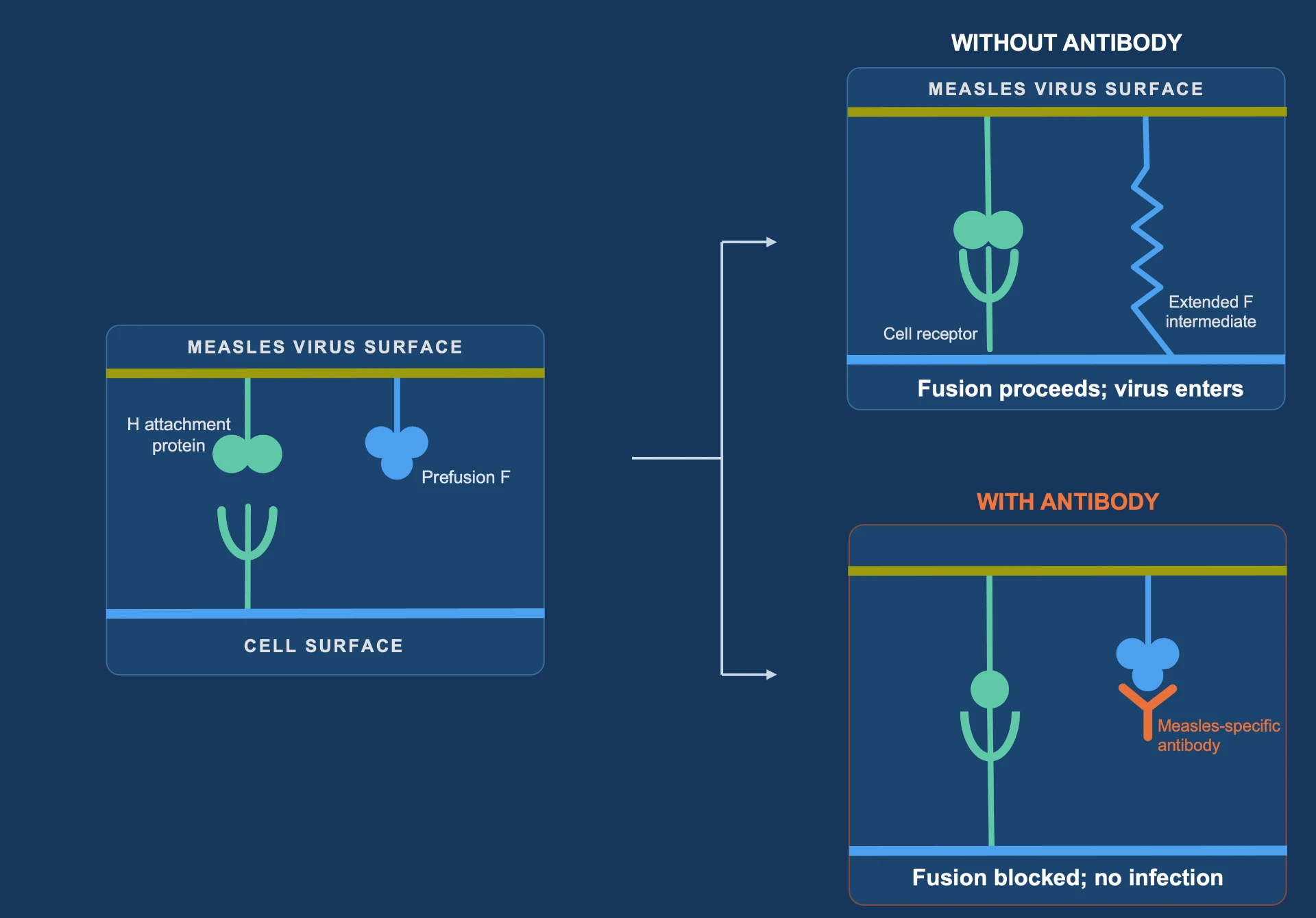
An antibody that blocks the virus from entering cells
Saravir’s investigational antibodies are designed to work immediately, without waiting for the body to build its own immune response.
The opportunity
Closing a critical gap in measles protection
Vaccination remains the foundation of measles prevention. However, some individuals cannot receive a live vaccine, do not develop adequate immunity, or require immediate protection following exposure.
Current passive-immunity options rely primarily on pooled immune globulin. Saravir is developing a standardized, measles-specific antibody product intended to provide potent and immediate protection for vulnerable populations.
The program
A targeted antibody approach
01
Recognize
Human monoclonal antibodies bind selected regions of the measles virus fusion protein.
02
Block
Antibody binding is designed to prevent the membrane-fusion process required for the virus to enter cells.
03
Protect
Passive antibody administration provides immediate protection without requiring the recipient to generate an immune response.
Evidence
Supported by preclinical research
Saravir’s antibodies are investigational. Safety and efficacy have not been established in humans, and no clinical studies have been completed.
Development progress
Building toward clinical development
- Completed
Antibody discovery
- Completed
Lead selection
- In progress
Candidate optimization
- Planned
Manufacturing development
- Planned
IND-enabling studies
- Planned
Regulatory submission
- Planned
Phase 1 clinical study
Team
Built by leaders in antiviral discovery and development
Ronald Moss, M.D.
Chief Executive Officer and President
Physician-scientist who has led antiviral and vaccine programs from early-stage research through late-stage clinical trials and NDA/BLA submission.
Andrew de Guttadauro
Chief Business Officer
Biopharmaceutical executive with more than 30 years of commercialization and business development experience.
Klaus Frueh, Ph.D.
Chief Scientific Officer
Immunologist and virologist conducting research in infectious disease and cancer immunotherapy.
James Crowe, M.D.
Inventor
Leads a human monoclonal antibody discovery program from which Saravir's measles antibodies originated.
Anne Moscona, M.D.
Scientific adviser
Virologist whose studies of paramyxovirus entry informed the design of entry-blocking strategies.
Company snapshot
A defined product-development program
- Company
- Saravir Biopharma, Inc.
- Lead program
- Measles-specific human monoclonal antibodies
- Stage
- Preclinical
- Initial intended use
- Prophylaxis after exposure to measles
- Technology origin
- Antibody research at Vanderbilt University Medical Center
Partnering to advance measles protection
Saravir welcomes discussions with biotechnology investors, pharmaceutical partners, global-health organizations, and public-sector stakeholders interested in advancing a differentiated antibody countermeasure against measles.